
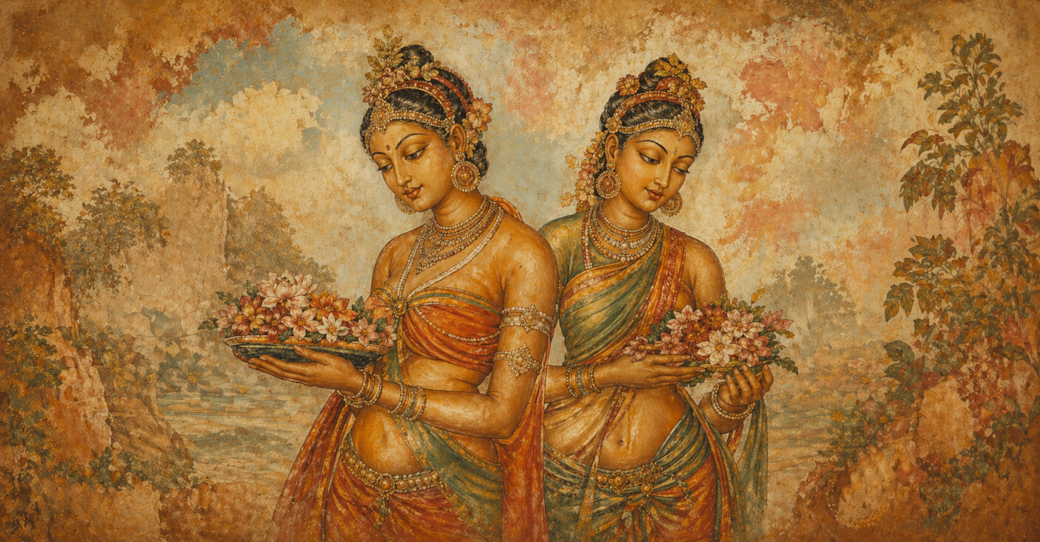
Sigiri Apsara – The Maidens of Sigiriya
A tribute to Sri Lanka’s ancient art, beauty, and imagination
The Sigiri Apsaras, often known as the Sigiriya Maidens, are among the most iconic artistic treasures of Sri Lanka. Painted on the western face of Sigiriya Rock, these graceful female figures are celebrated for their refined beauty, delicate expressions, rich colours, floral offerings, and elegant jewellery.
The exact identity of the figures remains open to interpretation. Some believe they represent celestial maidens or apsaras; others see them as royal women, consorts, goddesses, or symbolic figures connected to the ancient court of Sigiriya. Today, only a small number of these frescoes survive, but they remain one of the finest examples of early Sri Lankan painting. The Central Cultural Fund notes that the surviving frescoes reflect the sophistication of 5th-century Sinhalese art through their bold lines, rich colours, and naturalistic treatment.
The story of Sigiriya
Sigiriya, also known as Lion Rock, is one of Sri Lanka’s most remarkable historic sites. Rising dramatically from the surrounding jungle, the rock fortress was developed as a royal capital by King Kassapa I, who ruled from 477 to 495 CE. UNESCO describes Sigiriya as a granite peak rising around 180 metres, with the ruins of Kassapa’s capital spread across the slopes and summit.
The ancient city was designed with extraordinary ambition. It included palace structures, landscaped gardens, water gardens, terraces, stairways, defensive walls, rock shelters, and artistic spaces. The famous lion entrance once formed part of a grand stairway leading up the rock. Today, the enormous lion paws remain as one of Sigiriya’s most recognisable features.
Sigiriya is not only a fortress. It is also a symbol of ancient Sri Lankan engineering, urban planning, architecture, art, and imagination. Its gardens and water systems show a sophisticated understanding of landscape design, while its frescoes reveal the artistic refinement of the period.
Why this artwork was selected
This artwork was selected for YAKA Residences because it represents the elegance and depth of Sri Lankan heritage. The two female figures in the artwork are inspired by the Sigiriya fresco tradition: graceful, composed, richly adorned, and closely connected to nature through flowers and colour.
The artwork is not intended as a direct copy of the original frescoes. Instead, it is a respectful wall-art interpretation that brings the spirit of Sigiriya into a modern living space. The warm ochre, terracotta, gold, and green tones echo the feeling of ancient mural painting, while the two figures create a sense of calm, balance, and timeless beauty.
Design story
The design was chosen to feel like a fragment of an ancient wall brought into the apartment. The textured background recalls weathered plaster and rock surfaces, while the jewellery, flowers, and draped garments reflect the refinement of Sri Lankan visual culture.
The two figures also create a quiet sense of hospitality. They appear to hold floral offerings, almost as if welcoming the viewer into a sacred or royal space. This makes the artwork especially suitable for YAKA Residences, where the intention is to create not just accommodation, but an experience shaped by place, culture, and story.
A connection to Sri Lanka’s cultural triangle
Sigiriya sits within Sri Lanka’s Cultural Triangle, close to other major heritage sites such as Dambulla, Anuradhapura, and Polonnaruwa. For many visitors, it is one of the most memorable places in the country: a dramatic meeting point of nature, history, architecture, and legend.
By placing this artwork inside the apartment, YAKA Residences connects guests to one of Sri Lanka’s most powerful cultural symbols. It invites them to look beyond the image and discover the story behind it.
YAKA Residences note
At YAKA Residences, every design detail is intentionally selected. Our artwork is chosen to celebrate Sri Lanka’s landscapes, legends, architecture, and cultural identity.
This piece was selected to honour Sigiriya — not only as a historic fortress, but as a symbol of artistic imagination and timeless Sri Lankan beauty.
~ Every detail has a story ~