Kuweni – Queen of the Yaka
Echoes from Ancient Ceylon
In the ancient chronicles and legends of Ceylon, the Yaka are remembered as among the island’s earliest inhabitants. Often misunderstood through later folklore as mythical or supernatural beings, they can also be understood as a powerful indigenous people — deeply connected to nature, land, forests, rivers, and sacred spaces.
Long before kingdoms rose across the island, the Yaka were associated with guardianship, spiritual wisdom, and a close relationship with the earth. They belonged to the landscape and lived within its rhythms.
One of Sri Lanka’s most well-known origin legends, the story of Prince Vijaya and Queen Kuweni, is rooted in this Yaka heritage. Kuweni, described in tradition as a Yaka queen, stands at the meeting point of myth, memory, and identity.
Some Sri Lankans associate Kuweni with the origins of the Sinhalese people, as her story is closely linked to Vijaya’s arrival and the earliest legendary accounts of settlement on the island.
The story of Kuweni
When Prince Vijaya and his followers arrived on the shores of Lanka, Kuweni is said to have understood the land in a way the newcomers did not. She offered knowledge, shelter, and protection. She guided them through an unfamiliar world and helped them find a place within it.
In this reading of the story, Kuweni is not simply a tragic figure or a character from legend. She represents intelligence, strength, hospitality, and sacrifice. She is the woman of the land who receives the outsider, offers refuge, and becomes part of the island’s founding memory.
Her story is also one of loss and betrayal. After helping Vijaya, Kuweni is later abandoned, and her fate becomes one of exile and sorrow. This gives her legend a lasting emotional power. She represents both welcome and wound, belonging and displacement, strength and vulnerability.
The spirit of Yaka
The name YAKA is inspired by this deeper cultural legacy.
For YAKA Residences, the name does not represent fear or darkness. It represents protection, warmth, belonging, and a strong sense of place.
In the older imagination of the island, the Yaka were not merely creatures of myth. They were guardians of land, forest, water, and home. They symbolised strength, mystery, balance, and care.
That spirit quietly shapes the way we think about hospitality.
Just as Kuweni offered shelter and guidance to those who arrived on an unfamiliar shore, YAKA Residences aims to create spaces where guests feel safe, respected, and genuinely welcomed.
Why this artwork was selected
This artwork was chosen because Kuweni reflects one of the oldest and most meaningful stories connected to Sri Lanka.
She is not a monument, a beach, or a palace. She is memory. She is the voice of the land before recorded kingdoms. She represents the ancient relationship between people, place, protection, and hospitality.
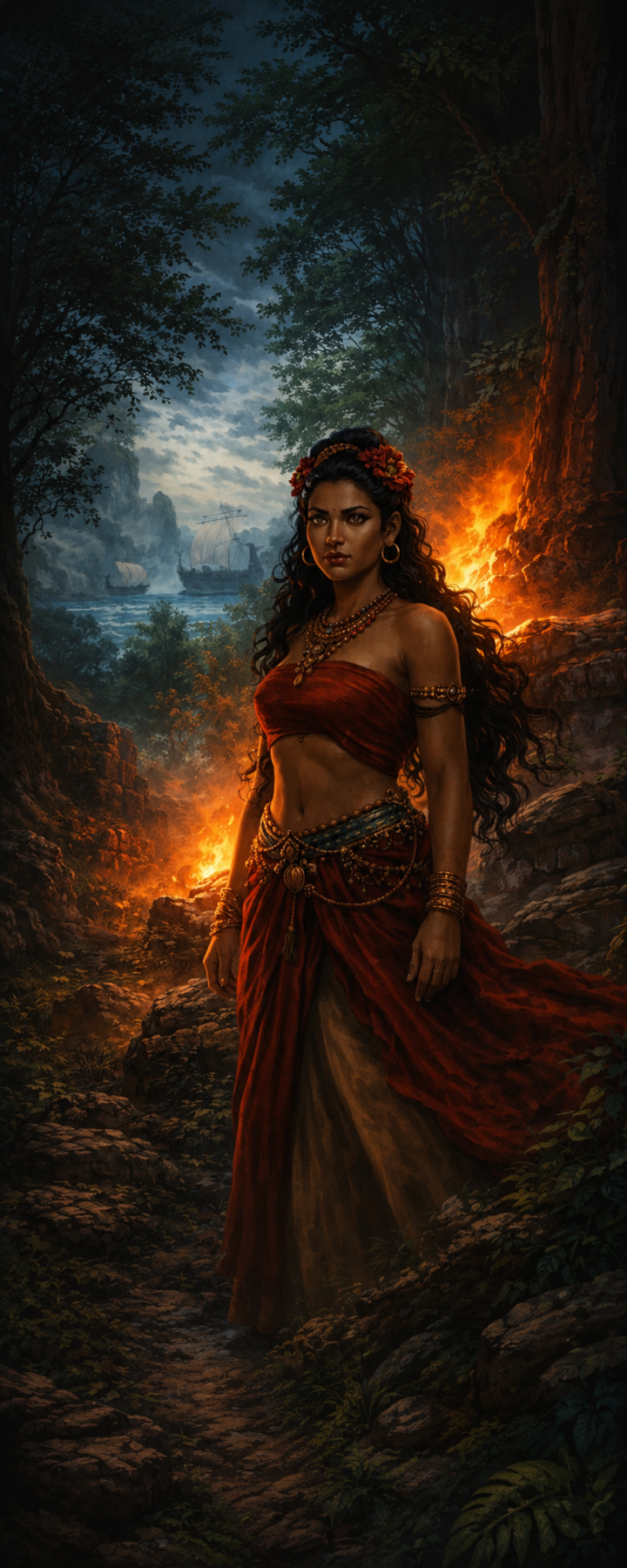
The dramatic forest setting, firelight, distant sea, and approaching ships in the artwork evoke a moment of arrival and transformation. Kuweni stands at the centre with strength and dignity — not as a passive figure, but as a guardian-like presence connected to the island’s earliest stories.
The contrast between cool mist and warm firelight reflects the dual nature of her legend: welcome and betrayal, beauty and danger, protection and loss.
Design story
The artwork uses a tall, cinematic composition to give Kuweni a commanding presence. Her red and earth-toned garments reflect warmth, strength, and ancient royalty. The jewellery, floral details, forest, rock, fire, and distant shoreline connect her to nature, ritual, and legend.
She is shown as a powerful woman of the island — watchful, intelligent, and deeply rooted in the land.
This piece is intended to remind guests that Sri Lanka’s story does not begin only with kings, monuments, and kingdoms. It also begins with women, forests, legends, guardians, and the sacred act of welcome.
YAKA Residences note
At YAKA Residences, every design detail is intentionally selected. Our artwork is chosen to celebrate Sri Lanka’s landscapes, legends, architecture, history, and cultural identity.
This piece honours Kuweni and the Yaka heritage as symbols of protection, strength, memory, and hospitality.